
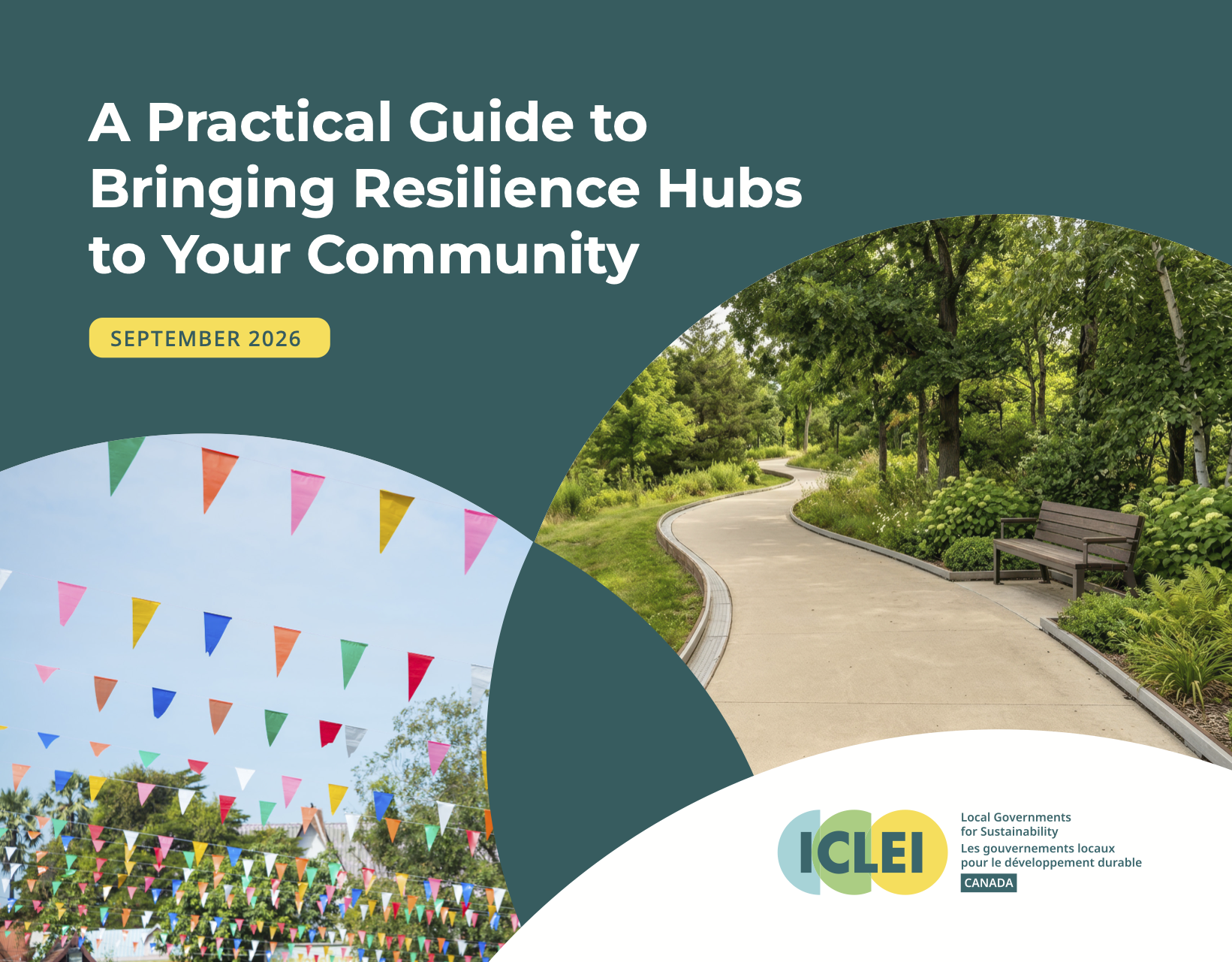
A Practical Guide to Bringing Resilience Hubs to Your Community
A Practical Guide to Bringing Resilience Hubs to Your Community
Framework for local governments to plan, implement, operate and monitor climate resilience hubs.
Resilience hubs are trusted community spaces that provide physical and social infrastructure needed to prevent, prepare for, respond to, and recover from climate impacts. Hubs can take many forms and serve communities of all sizes, from urban neighbourhoods to rural, northern, and remote communities. They provide a reliable anchor where communities can access essential services, resources, and support before, during, and after climate events. Depending on how they are planned, designed, sited, and governed, resilience hubs can also help advance equity, climate change mitigation, and other community co-benefits.
A Practical Guide to Bringing Resilience Hubs to Your Community provides local government staff and community partners with practical, equity-informed guidance for every stage of the resilience hub lifecycle, from early planning and partnership development to service design, implementation, activation, operations, monitoring, and evaluation.
- Overview of different climate resilience hub models available to meet diverse community needs;
- Step-by-step guidance covering project initiation, governance and goal setting, background research and risk assessment, planning and service co-design, and implementation and activation of resilience hubs;
- Checklists, indicators, and tools to monitor, assess, and track hub performance and support continuous improvement; and
- Case stories of a variety of hub models implemented across Canada sharing replicable examples and lessons learned.
Find the hub model and approach that fits your community’s needs.
Webinar: Bringing Resilience Hubs to Your Community
As communities face more frequent and severe climate events, alongside rising social isolation and inequitable access to essential services, resilience hubs offer a promising approach to address both the physical and social dimensions of these challenges while delivering a range of co-benefits.
Join us for the launch of A Practical Guide to Bringing Resilience Hubs to Your Community, a new resource designed to help communities across Canada develop and implement resilience hubs. Explore how to select a hub model that fits your community, plan for implementation and monitoring, and learn from real-life case stories from communities putting resilience hubs into practice.
About Coastal Climate Resilience Collaborative

This resource was developed by ICLEI Canada as part of the Coastal Climate Resilience Collaborative (CCRC) initiative—supported by Natural Resources Canada’s Climate-Resilient Coastal Communities Program—with additional support from the Ontario Resource Centre for Climate Adaptation (ORCCA).

Discover similar resources
Reach us
401 Richmond St. W
Toronto, ON
M5V 3A8