
Reflections on Adaptation Canada from our Managing Director
Reflections based on remarks delivered by Ewa Jackson, ICLEI Canada Managing Director, during the closing plenary of Adaptation Canada 2026 on Thursday, September 24, 2026.
Adaptation and uncertainty
Reflecting back on Adaptation Canada 2026 it’s become clear that we are living and working in deeply uncertain times.
Climate impacts are accelerating, budgets are tightening, political priorities are shifting, and communities are being asked to prepare for risks that are changing faster than many of our systems can respond. We need to ask ourselves honestly: what are we still treating as temporary that has actually become our new operating context?
Uncertainty is not something we can wait out and expect to pass—it is now the environment in which adaptation work happens. This does not mean that we must accept instability, or lower our climate ambitions. But, it does mean being clear-eyed about the world we have, not only the world we wish we had, and finding ways to act within this reality.
The reality of action in the face of emergency
Throughout Adaptation Canada, we heard the stories of communities facing wildfires, flooding, extreme heat, coastal erosion, and changing permafrost conditions. Sessions openly discussed gaps in infrastructure, funding, and capacity.
But, delegates and speakers alike also shared stories of continuing to move climate adaptation forward. Across Canada, individuals and organizations are building partnerships that did not exist before, finding money in budgets that were never designed for adaptation, and translating climate data into decisions. To this end, they are maintaining relationships, often quietly and over many years, so that when a crisis arrives, people already know whom to call.
This is the reality of advancing resilience. Resilience work is not always launching a bold new project with a ribbon to cut. Often, it is: maintenance, coordination, building trust, having difficult conversations, protecting a budget line for one more year, or being the person inside an organization who keeps asking the question everyone else is tempted to defer. Those question-askers—and the difficult decisions they are being asked to make—are holding much of this work together.

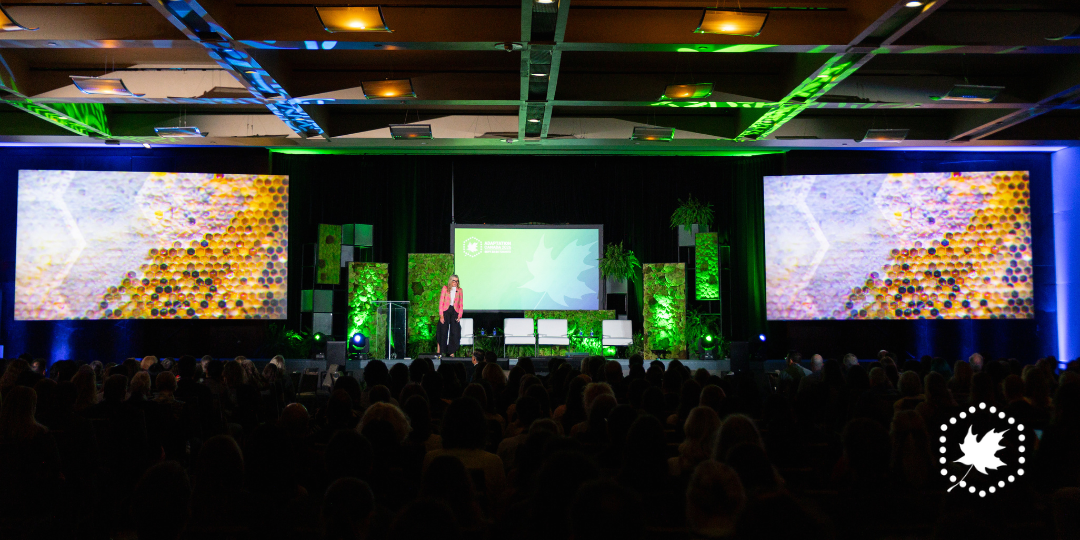
Revisit Adaptation Canada 2026 photos and presentation.
Complex, nuanced paths forward
Too often, we are pushed to reduce complex questions to black-and-white choices, even when neither side reflects the reality in front of us. Too many choices are framed as either-or:
- urgent action or long-term planning;
- public investment or private capital;
- technology or nature-based solutions;
- local knowledge or technical expertise.
But adaptation rarely offers us that kind of simplicity, and instead requires nuance. We need engineered flood protection and restored wetlands. We need to respond to an emergency today, while changing the systems that created vulnerability over decades or even centuries. We need governments to lead and businesses to invest. We need strong national standards and solutions designed around the realities of a particular place. Sometimes the honest answer is that we have to do both.
This includes having an honest conversation about money. We cannot continue asking communities and practitioners to do more with less, as though ingenuity can permanently substitute for investment. Yes, we need to use resources well. We need new partners, new financial tools and more private capital. But, we also need sustained public funding, because resilience is a public good and because many of its most important benefits cannot be adequately captured on a balance sheet. The question is not simply how we pay for adaptation. It is how we recognize its value, share its costs fairly and direct resources to the people and places that we need to protect.
All of this can be uncomfortable. Nuance does not fit neatly into a slogan, and it rarely produces a perfect decision. But, adaptation is not about waiting for perfect certainty. It is about making responsible choices with the knowledge, resources and relationships available to us, and being prepared to adjust as conditions change.
Collaboration and determination
Those responsible choices are rarely made, or carried out, by one person or institution alone. They depend on how well our different strengths and capacities connect, which is why the hexagon was such an important motif at Adaptation Canada. Like the cells of a honeycomb, which lean and rely on each other, no community, government, organization or sector can carry the work of adaptation alone. Our task is to connect those contributions well enough that they become more than a collection of individual efforts.
At the conference, I was struck by how much determination there is in the adaptation community. Not blind optimism, and certainly not a denial of how difficult the road ahead will be, but something more grounded than that. It’s the determination to keep working without knowing exactly how everything will unfold; to make the best decision available, learn from it and keep moving; to hold onto ambition, while remaining honest about constraints; and to understand that hope is not just the belief that things will somehow work out, but the decision that the work is worth doing.
With the conference behind us, I hope we are carrying forward more than information and business cards. I hope we carry a greater willingness to work in the complexity, to resist false choices, to value the people maintaining momentum between major announcements and moments of crisis, and to recognize where our own hexagon connects to the hexagon of others. Because a climate-ready Canada will not be delivered through one strategy, one investment or one institution. It will be built decision by decision, relationship by relationship, and community by community.
That is the work ahead. And it is already underway.
Reach us
ICLEI Canada
401 Richmond St W (Suite 204)
Toronto, ON M5V 3A8